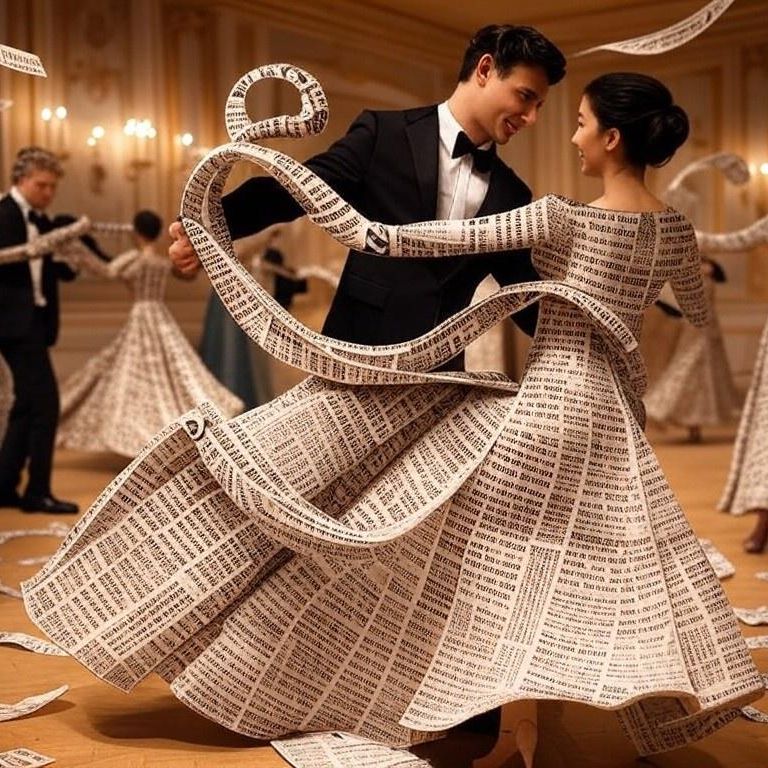
The waltz of information
Winter is shaping up to be harsh and severe for all the small newspaper vendors. It had rained so much in recent months, as if trying to wash away their misfortune. However, a strange piece of news appeared on the front page of all the newspapers.
But what could it be about?
An unexpected death? A bank robbery? Or the sudden resignation of a man of great political importance? Not really. It was simply a small, insignificant sentence that took on incredible proportions.
What was this little newspaper, still so big at the end of last fall, trying to say? It always predicted good weather for our lives, our little house where the garden was becoming almost useless because nothing was planted there except fear.
And then winter burst in, sweeping away the dead leaves and ordering them to rot so that the good, fertile soil of spring could come. For this season is also coming for our dear little newspaper, the unwitting hero of my story today.
André, the editor-in-chief, no longer knew what news to announce to his readers, except perhaps that it was time to change the tone of his discourse. But how?
By firing his current interns?
By looking for fresh news in the salad bowl of American turpitude?
Or perhaps by seeking out other collaborators who enjoy raking fallen leaves in winter to discover what lies planted beneath.
And then Nadège arrived, looking beautiful with her brown curls and her talent as a budding writer. Her mother had always given her pens and other writing implements to embellish her words. She came from nowhere with her little brown bag that made her look strict. One wondered if she had a sense of humor, seeing her so serious with her hair pulled back and black-rimmed glasses.
Nadège loved the truth. That morning, she strangely reminded André that she was quite willing to work for a newspaper like his. And she did so immediately, without delay or endless discussions about salary or benefits.
The editor-in-chief was amazed by her aptitude for the job and, without thinking twice, hired her. He thought this was the best way to boost the declining turnover of his news company, which had been delivering to homes for almost a hundred years.
All this made him forget that he had to check the articles to ensure they did not conflict with the usual circle of right-thinking people.
And then Nadège arrived, looking beautiful with her brown curls and her talent as a budding writer. Her mother had always given her pens and other writing implements to embellish her words. She came from nowhere with her little brown bag that gave her a stern look. One wonders if
And it was Nadège, with her stiff little bun, who reminded him of this. She was uncompromising with the truth. Her first article was about women: those beautiful, eternal plants that the universe had designed to be as elegant as they were hard-working, raising not only children and beautiful carrots in the vegetable garden, but also raising minds to a proper understanding of the world around them.
And our dear Nadège was not the type to be discouraged by the recent prolonged autumn rains, thus leaving the field open for her good word of truth.
She asked André to correct her spelling mistakes before layout and publication. But he jumped up from his old armchair, the dictator of information on the pages of his newspaper.
“I can't publish that!”
“Why not?” Nadège asked, looking both innocent and sharp at the same time.
“Because... Because... Because I'll have to shut down my newspaper if I publish this!”
Really?” she said, surprised. “Isn't your newspaper already bankrupt? Isn't that why you hired me?” She replied with consummate skill, making it clear that the truth is not always easy to publish or even accept.
André sat down, picked up his glasses, and began to reread the article written in Nadège's beautiful handwriting, and she didn't mince words. She preferred the pen to the ugly lie of good truth for those who choose to see nothing at all of what is happening around them. And Nadège had hit the nail on the head, because André was no fool, far from it; his intelligence was above average. And yet he had not seen coming what his new journalist described in her article. He thought he was an honest and respectable figure, while the truth was trying to show him that he was heading down the path of bad news that should never be published. With the intention of not losing the attention of those who are truly seeking it, this beautiful truth.
And then Nadège, in two or three well-written paragraphs, explained to him that the truth lay behind the fear of never being in reality. What a mess this story was.
But not really, because the truth is often hidden behind the most shameless lies of everyday life. The ones we tell ourselves when we seek peace. Like, “Leave me alone, I want to watch Netflix without being bothered by the fear of getting sick from everything. So I'm vaccinating myself against any ideas that might disturb my usual peace of mind.”
Nadège took the time to explain all this in a beautiful article, in which she asked people to stop buying newspapers because they told nothing but lies and that it was better to leave journalists alone, even though she was part of that profession herself.
But how would the readers of our dear André react to this article? Would they throw the newspapers in the trash, unsubscribe from everything, even the Monday sports page? Or would they simply come to their senses by reading these same articles with this newfound clarity?
It was a good question that André asked himself. Should he publish Nadège's article or do as usual and publish messages that were as contradictory as they were useless for understanding the current world, when Nadège's article sparked a very interesting debate?
André thought about it over and over again for at least an hour. It was a long time for a man like him, who was quick to publish his newspaper on time. But today he was confronted with fear, the fear of facing reality on his computer screen.The one who, for once, was open to the page of the usual little dilettante of information, when the dispatch from the news agency announced the opposite of what he understood about the world.
Who was André?
Today was the day he had to make up his mind, because not only was his financial future and, above all, that of the newspaper at stake, but also his own integrity in light of everything he now understood about himself, the world, and his profession. He had to react, but how?
So he put his trust in Nadège, whose severity but great insight comforted him in the beautiful vision of the world that he too had had when he started out. He quickly looked back over his past to see that he had become one of those bedridden purveyors of information for the general public. Those who, not wanting to scare readers, put them into a state of torpor, only to discover now that they had been wrong all along. But how could he repair the damage done over the last few years by this newspaper, which was read by generations of families in his beautiful country?
He made his first decision of the year by publishing Nadège's article and, contrary to his fears that he was sabotaging himself, his newspaper grew in popularity until it sold out in a single day.
He couldn't believe that telling the truth about him could finally restore his credibility with his readers. So that was the secret to his newspaper's profitability: the truth. Well, he worked twice as hard in the days and months that followed, only to be imitated by his competitors on all sides. In fact, she also realized that André's business strategy was profitable. But only newspapers that didn't sensationalize stories and stuck to useless truths were successful, whereas André's stories challenged not society as a whole but a system of single-minded thinking based on fear, money, and the false peace of the evening news.
Our dear Nadège spent two or three months with André before leaving to help other equally intelligent people. Those who were sometimes lost in a peaceful existence that brought only meager or no rewards, when the good friendship of a thought firmly anchored in one's inner self through the truth we hold towards ourselves takes over.
So there you have it, her work was done, and André had taken with him most of the local newspapers, which also did not want to die from the lie told to their former intelligence.Because intelligence and culture are meaningless if the truth about them becomes obsolete and meaningless. Indeed, many people are very intelligent, understand words, sentences, numbers, music, and music theory, but do they really know how to use this knowledge in truth?
It's a good question, isn't it? Because starting by understanding how we function and why allows humanity to ask the right questions. And this without fear of offending any scientist in any field by saying, “Hey, guys, I think we're heading in the wrong direction.”
And that's where Nadège and André showed us the flaw in our beautiful intellectual system, when we forget to include the right kind of peace. Not the kind in the movie that numbs our conscience for an evening, but the kind that allows us to face the truth without trembling. Because we know how to be intelligent and understand that failure can be avoided if we understand its symbols and, above all, the truth about it.
It was a good idea that Nadège had, after all. But who she?
Well, a young woman, not so young in reality, because her old soul apparently wanders from apocalypse to apocalypse on our planet to restore truth to the affairs of this world, when the time is finally right. And apparently it must be favorable, because Nadège never travels for nothing. So let's wait and see if all the Andrés of the world start publishing beautiful and truthful information, full of cold blood and straightforward contextualization, to preserve one camp or another, be it blue, white, black, or red.s.